

Your Tools Are Teaching Shoppers to Spend Less
How mission builders, smarter sequencing, and a Thursday cart can stop the bleed.

This is the second post in a 5-part series, The Unit Problem, on how grocers can reverse unit volume contraction. We started here.
TL;DR
Digital grocery tools are training shoppers to prune their baskets. A visible running total is not neutral. It triggers anxiety, and high-margin items come out before checkout.
The fix is upstream: mission-based entry points, pre-built weekly baskets in the Thursday planning window, savings summaries before the total, and QR codes that turn in-store displays into digital carts.
The shopper is not the problem. The interface is.
The grocery apps and sites were supposed to drive basket size. They’re doing the exact opposite.
A shopper building a cart online has something no in-store shopper has ever had: a running total, visible at all times, and updated with every item added. The behavioral consequence is predictable. When the number gets uncomfortable, items come out. The planned items remain, but the high-margin items, the impulse additions and premium versions, would have gone in the cart without a second thought in the store.
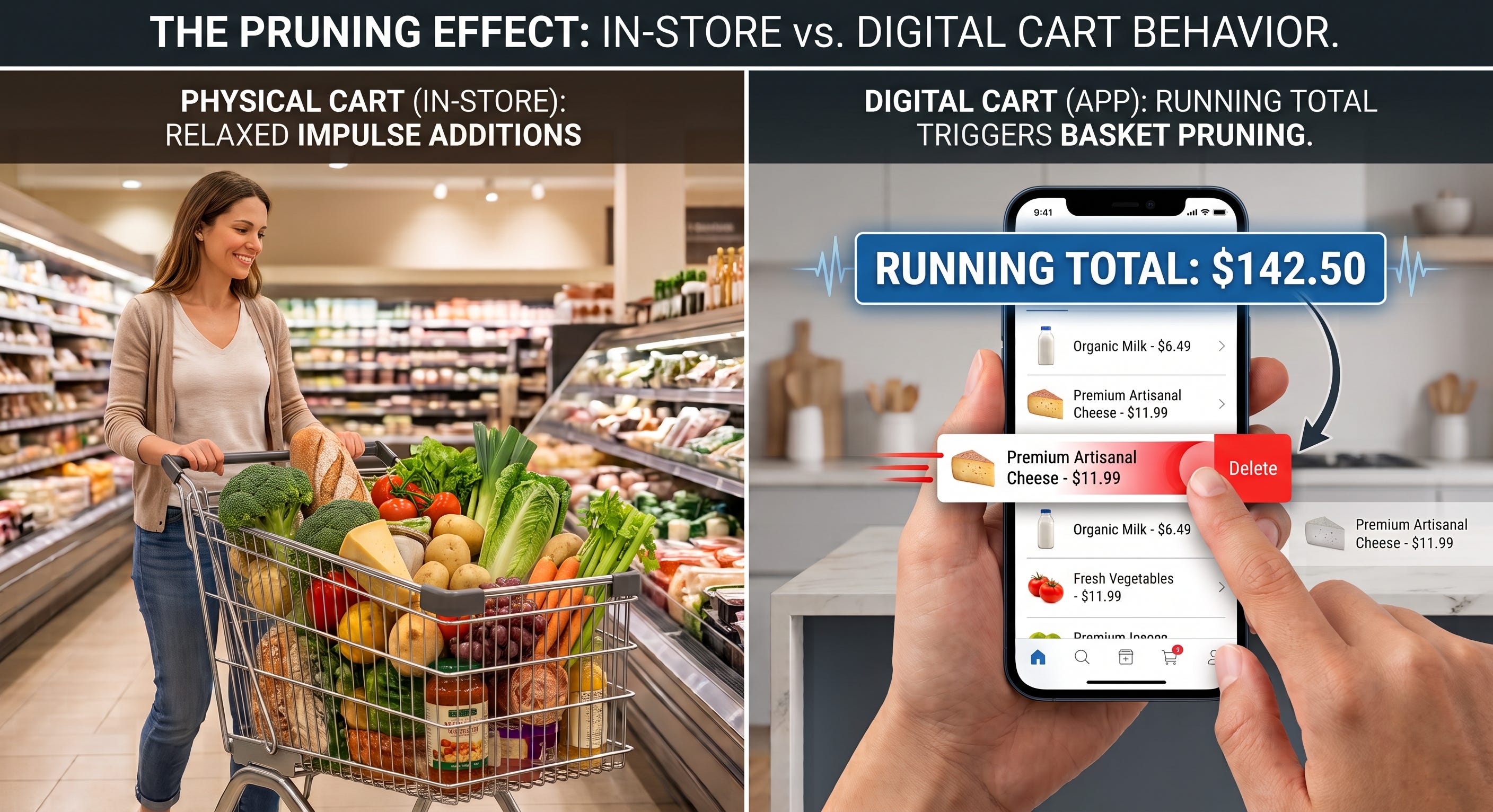
This is basket pruning. It is a structural feature of the digital grocery channel. The shoppers who removed three items before checkout are not behaving irrationally. They’re doing exactly what the interface trained them to do.
Showing the cart total is not the problem. What the shoppers think about before they get there is.
McKinsey’s State of Grocery North America 2026 documents the channel shift driving this pattern. Purchase frequency increased 5% year over year from August 2024 to August 2025, while units per trip fell across every major grocery channel1. Shoppers are coming more often and buying less each time, splitting missions across banners, channels, and delivery platforms based on where the value lands this week.
I saw this same pattern eight years ago: omnichannel shoppers allocate 31% of their grocery spend to a given retailer, compared with 26% who only shop in-store. Cross-channel shoppers spend more. The digital channels, as most grocers have built them, are quietly eating that advantage.
The fix is not incremental.
From Convenience Tool to Mission Builder
Current grocery apps and sites are built around a search bar and a cart. Shoppers arrive with vague lists, search for items, and add them as they watch the total grow. Then they remove anything that pushes past a mental threshold. The channels are neutral containers, and neutral containers get pruned.
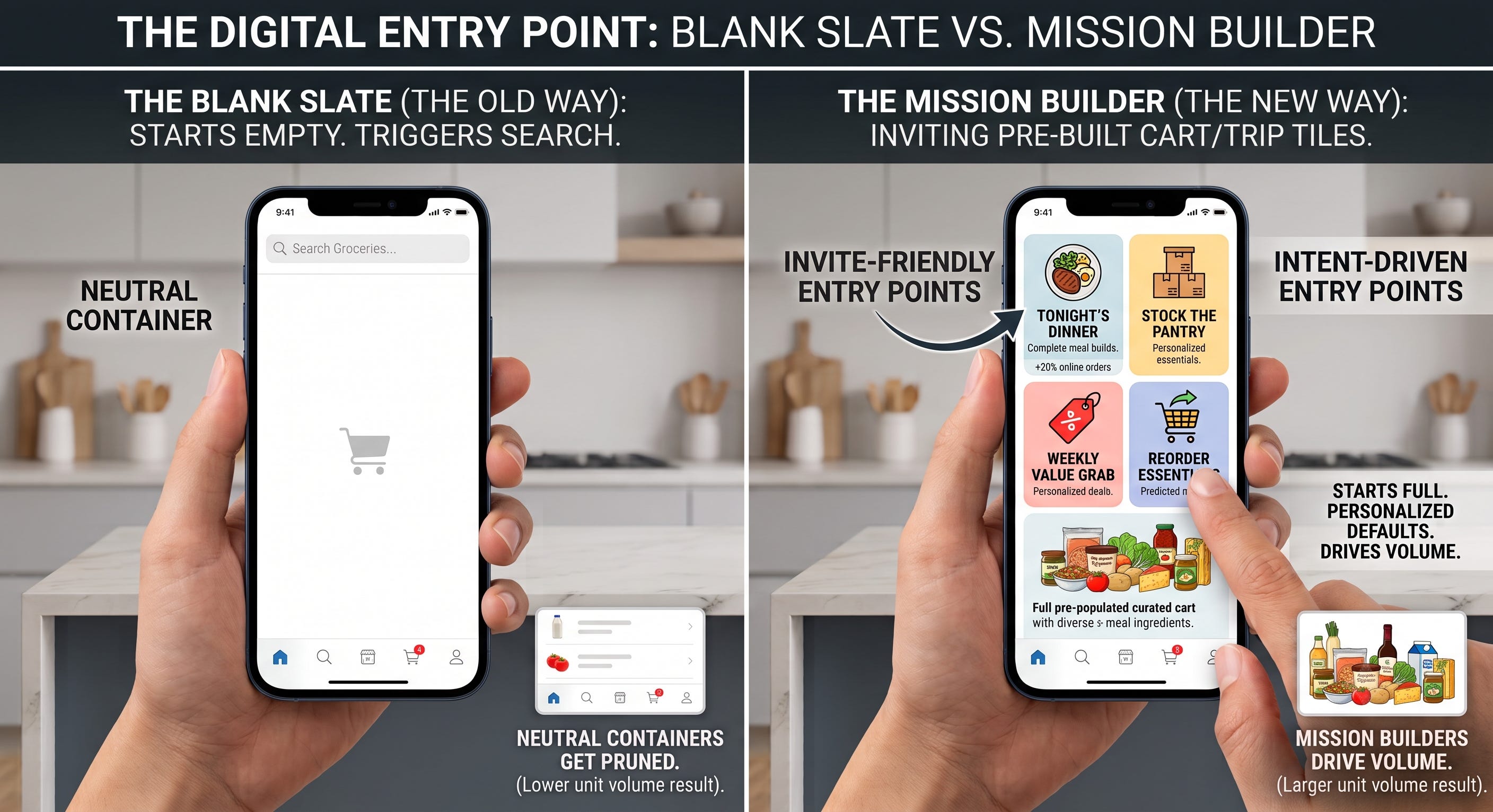
Mission builders change the entry point. Instead of a blank search experience, shoppers arrive at intent-driven entry points: “Tonight’s Dinner,” “Stock the Pantry,” “Reorder Essentials,” and “Weekly Value Grab.” Each path feeds a curated or predicted cart of products built for that specific trip type, with items pre-selected from past purchases and the current promotions.
Shoppers who enter through “Tonight’s Dinner” will not prune a basket. They’re choosing between two meal configurations that are already complete. The usual behavior has nowhere to operate because the carts were assembled before they touched them.
Kroger and some grocers are already seeing more than 20% of online orders come from recommended or preassembled carts, according to McKinsey. The behavior exists. Most grocers are not building toward it deliberately.
The Smart Basket Push
The highest-leverage version of this is a pre-built weekly basket delivered to the shopper before the shop begins.
The mechanic: every Thursday, the app pushes a household-specific replenishment basket built from purchase cadence, average pack size, time since last purchase, recommended recipes, and the week’s personalized offers. The shopper opens it, reviews, adds or removes items, and confirms. The cart starts full, not empty.
The behavioral difference matters. A shopper editing a complete cart removes less than one building from zero. Defaults are sticky. Items that go in before the shopper touches the experience tend to stay in.
Reframing the Checkout Moment
Before the cart total appears, reinforce the savings summary first: loyalty credits applied, bundle discounts captured, and private label savings versus national brand equivalents.
The sequence matters. Shoppers who see “You saved $8.40 this week” before they see the cart total are in a different mindset than those who see $94 and start pruning. Right now, most digital tools present the number that triggers anxiety before the number that provides relief.
Pair this with a basket completion prompt. When a digital cart reflects a recognizable build but is missing something, surface one targeted offer to fill the gap. Not three. One, specific to what is actually missing.
The grocer that knows a household always buys chicken thighs and salad dressing together. When there's only chicken in the cart, surface the salad dressing.
The Physical Store as Digital Activation Engine
The same shoppers who pruned their baskets online are standing in your store with full purchase intent and no running total in their heads. Digital is invisible at this moment when shoppers are most ready to buy.
End caps, fresh perimeter displays, and seasonal fixtures carry enormous foot traffic but don’t deliver digital conversions. This is free media inside a physical space the grocer already owns, and it is almost entirely unused. Adding a QR code to a display that links to a curated basket costs almost nothing to produce. It converts a physical browse into a digital cart start.
Shoppers who scan tend to complete the cart. The ones who do not scan buy what they remember and leave.
Consumers who are buying fewer items, trimming non-essentials, and cross-shopping three banners will not respond to a better search bar. They will respond to an experience that makes value visible before their anxiety sets in. Give them a complete cart to edit, not a blank slate to fill. And make sure it shows up in their Thursday planning window.
That is the difference between digital tools that prune and those that deliver.
The Unit Problem is a five-part series on why US grocery unit volume is falling and what traditional grocers can actually do about it. Next, we’ll cover how partnerships can move unit volume externally.
“The State of Grocery North America 2026.” McKinsey: https://www.mckinsey.com/industries/retail/our-insights/the-state-of-grocery-north-america