

$4.75, Already Applied
The Sunday circular treats every shopper the same. Your loyalty data knows better. That gap is where unit volume goes.

This is the final post in a 5-part series, The Unit Problem, on how grocers can reverse unit volume contraction. Here’s where we started.
TL;DR
Broadcasting the same 40 deals to every loyalty member is not a promotion strategy. It is unit volume leaving. The grocers closing that gap are not building new technology. They are using purchase history they already have to personalize offers, timing replenishment, and do the coupon work before the shopper opens the app. This final post in the series ends with a 90-day test you can take into a budget meeting.
Most grocery apps greet you with a coupon library. Browse hundreds of offers, find the relevant ones, clip each manually, and remember them at checkout. Shoppers doing that in 2026 are already doing more work than they should.
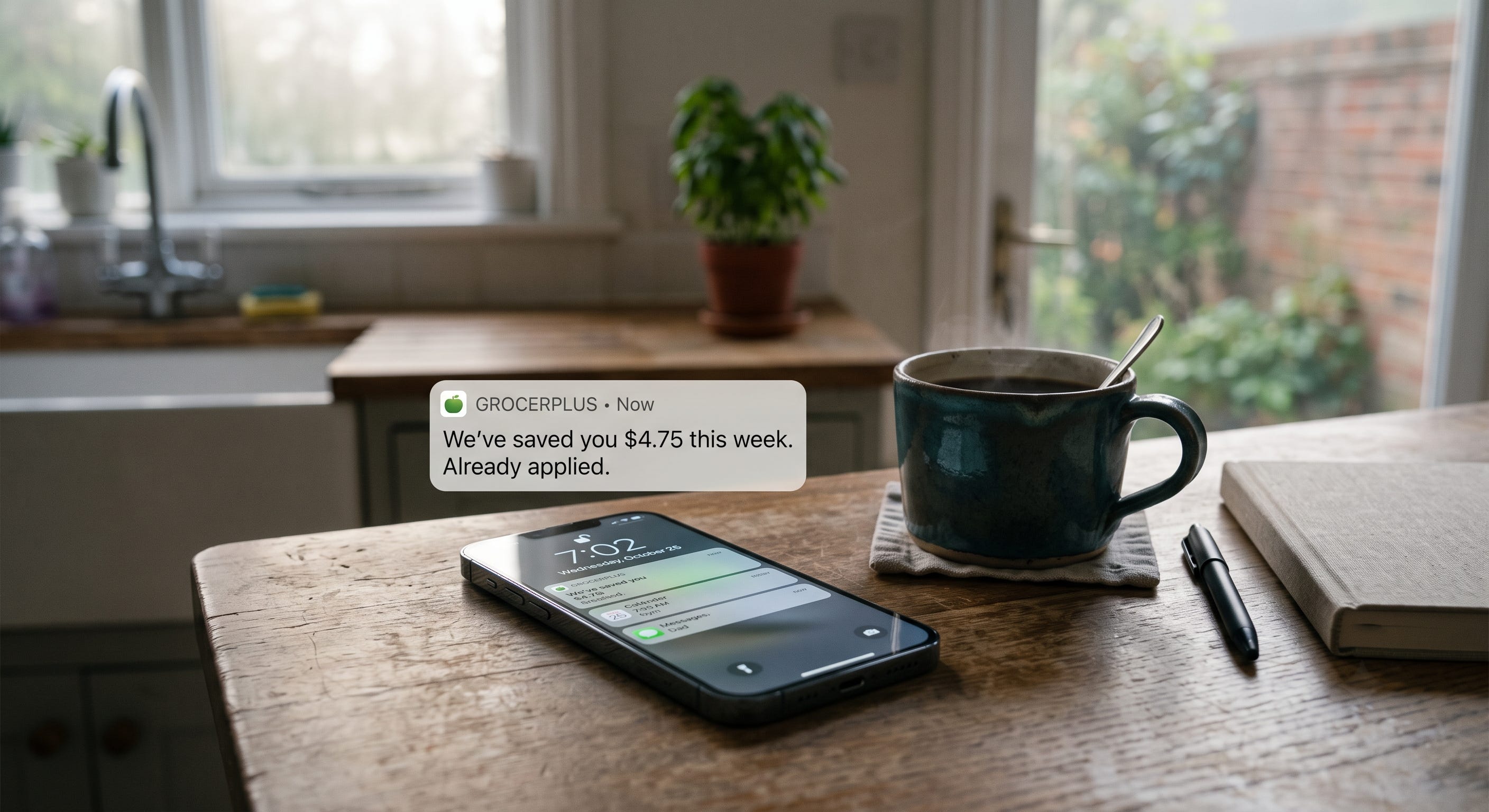
One banner figured out a different greeting. She opens the app and sees: “We’ve saved you $4.75 this week. Already applied.” No clipping. No browsing. The grocer did the work before she even wrote her list.
44% of consumers are leaning harder on coupons and promotions right now.1 That number will not surprise anyone reading this. What should surprise you is how few grocers have figured out what that shopper actually wants from the experience.
Every extra click you make her take is unit volume walking out the door to someone who did the work for her.
What AI Is Actually Good For Here
68% of food retailers surveyed by FMI in early 2026 said they use AI in their business, up from 47% a year ago. Technology spending averaged nearly 2% of total sales in 2025, double what it was in 2024.2
Most of that investment is going into consumer-facing AI: chatbots, search improvements, and product recommendation carousels. These are real applications. None of them are where the unit-volume leverage lives. (Review the Grocery AI Pyramid.)
The AI that actually moves units works at the household prediction level. It is not visible to the shopper as “AI.” It shows up as an offer that feels like the grocer actually knows her.
McKinsey’s data shows grocers currently report 35% of promotions are fully personalized, and expect that share to reach 55% in two to three years.3 The grocer that reaches 55% by mid-2027 instead of late-2028 has a loyalty and unit advantage during the exact window when shoppers are most open to switching banners.
How the Engine Actually Works
The architecture is not complicated. It starts with purchase velocity: AI identifies which households are running low on which categories based on purchase cadence, pack size, and days since last purchase. A household that buys a 32-ounce Greek yogurt every 10 days is probably out by day 8. That is a known fact sitting in POS data that most grocers are not using.
From there, the offer writes itself. Not “buy 2 get 1 free” on a shelf tag, but a push notification: “You’re probably out of Greek yogurt. Buy 3 and save $2.50, good until Saturday.” That unit pull is real because the household was going to buy one anyway and is now buying three.
The last piece is basket completion. When a digital cart reflects a recognizable mission but is missing something the household always buys on that mission, surface one targeted offer to close the gap. A household that always pairs chicken thighs with salad dressing but only has chicken in this basket gets one prompt: “Complete the meal, 20% off your usual dressing today.”
These offers are not generic. The unit volume goes up because the prompt answered a question the shopper was going to answer somewhere else.
The 44% Coupon Cohort
The shopper clipping coupons in 2026 is not who you think she is. She is not stretching a tight budget and hoping for the best. She is a high-frequency, high-intent shopper telling you exactly what she values. The problem is the coupon experience most grocers hand her.
A paper coupon in a Sunday insert requires her to find it, clip it, remember it, and present it at checkout. A digital coupon library requires her to browse hundreds of offers, identify the relevant ones, and manually clip each before she shops. Both formats add friction at exactly the moment you want it eliminated.
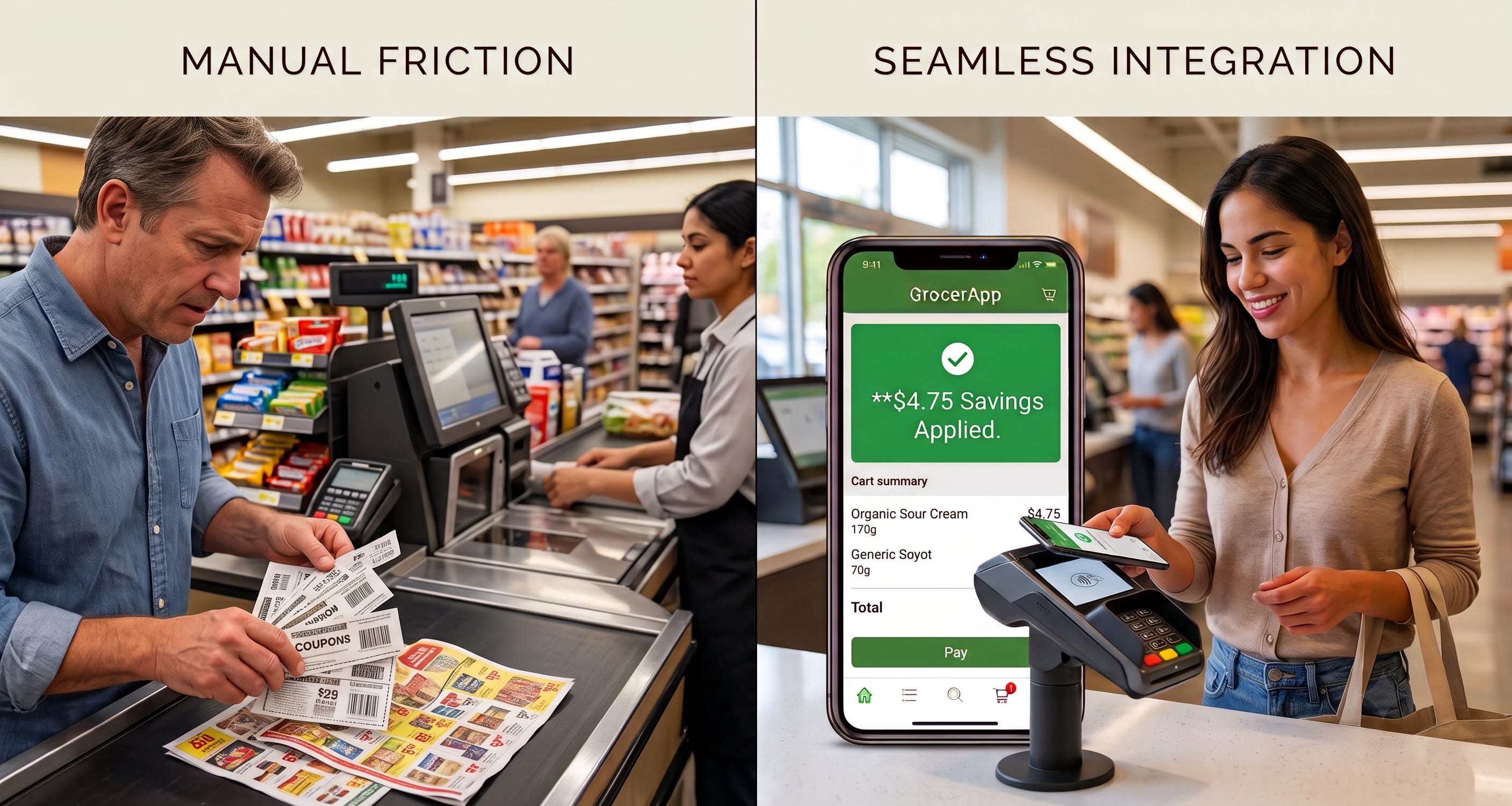
The move is automatic application. Before each shop, the system identifies every offer in the weekly set that is relevant to the household’s purchase history and applies it to the loyalty account without any action required. She opens the app and sees: “We’ve saved you $4.75 this week. Already applied.” She did not have to do anything to earn that. The grocer did.
The behavioral consequence is straightforward. A shopper who gets that feels recognized. She connects that feeling to the banner. She is less likely to do her coupon sweep at a competitor because the competitor requires her to do the work herself.
This is not a complex feature to build. It is a policy decision about how coupons work, combined with a loyalty data integration that already exists in most modern grocery tech stacks. The tech is easy. The willingness to change is not.
Connecting the Series
The promotional engine is the piece that connects everything. It is the connective tissue that makes everything in this series work.
The mission-based app architecture from the second post generates the basket start. The friction fixes from the fourth post keep shoppers in the app long enough to build a full list. The AI engine fills it with personalized offers and bundle recommendations. The GLP-1 telehealth partnership from the third post feeds new household acquisition into the loyalty database, where the engine immediately begins learning the new shopper's behavior.
These are not four separate strategies. They are one strategy with four execution layers. The grocer running four disconnected initiatives loses to the one that built a system.
The 90-Day Starting Point
Pull 12 months of POS and loyalty transaction data for the top 20 SKUs by household penetration. Run a repurchase interval analysis: average days between purchases by SKU and household segment. Identify the five SKUs with the most consistent repurchase cadence. Those are the first five items for the bundle offer test.
Build a control group of 500 loyalty households and a test group of 500. Push a replenishment offer to the test group for those five SKUs in week 3 of the next promotional cycle. Measure unit pull at the SKU level and total basket impact at the household level over four weeks.
That test costs almost nothing. It runs on existing loyalty infrastructure. It produces a result the CFO can read. And it is the data that justifies everything else in this series.
Grocery unit volume will not recover because the macro improves. It will recover because individual grocers build systems that earn back the trust and trip frequency of shoppers who are currently hedging across four banners and pruning every cart.
The grocers that pull ahead will be the ones that figured out how to win during the contraction. The ones that waited for it to end will find the winners already dug in.
The Unit Problem is a five-part series on why US grocery unit volume is falling and what traditional grocers can actually do about it.
“The US Grocery Slowdown Is Real.” Bain & Company: https://www.bain.com/insights/the-us-grocery-slowdown-is-real-snap-chart
“Grocers Are Quickly Embracing AI, Research Shows.” Grocery Dive: https://www.grocerydive.com/news/grocers-artificial-intelligence-technology-spending-fmi
“The State of Grocery North America 2026.” McKinsey & Company: https://www.mckinsey.com/industries/retail/our-insights/the-state-of-grocery-north-america