

The Unit Problem
The accounting looks fine. The volume story doesn't.

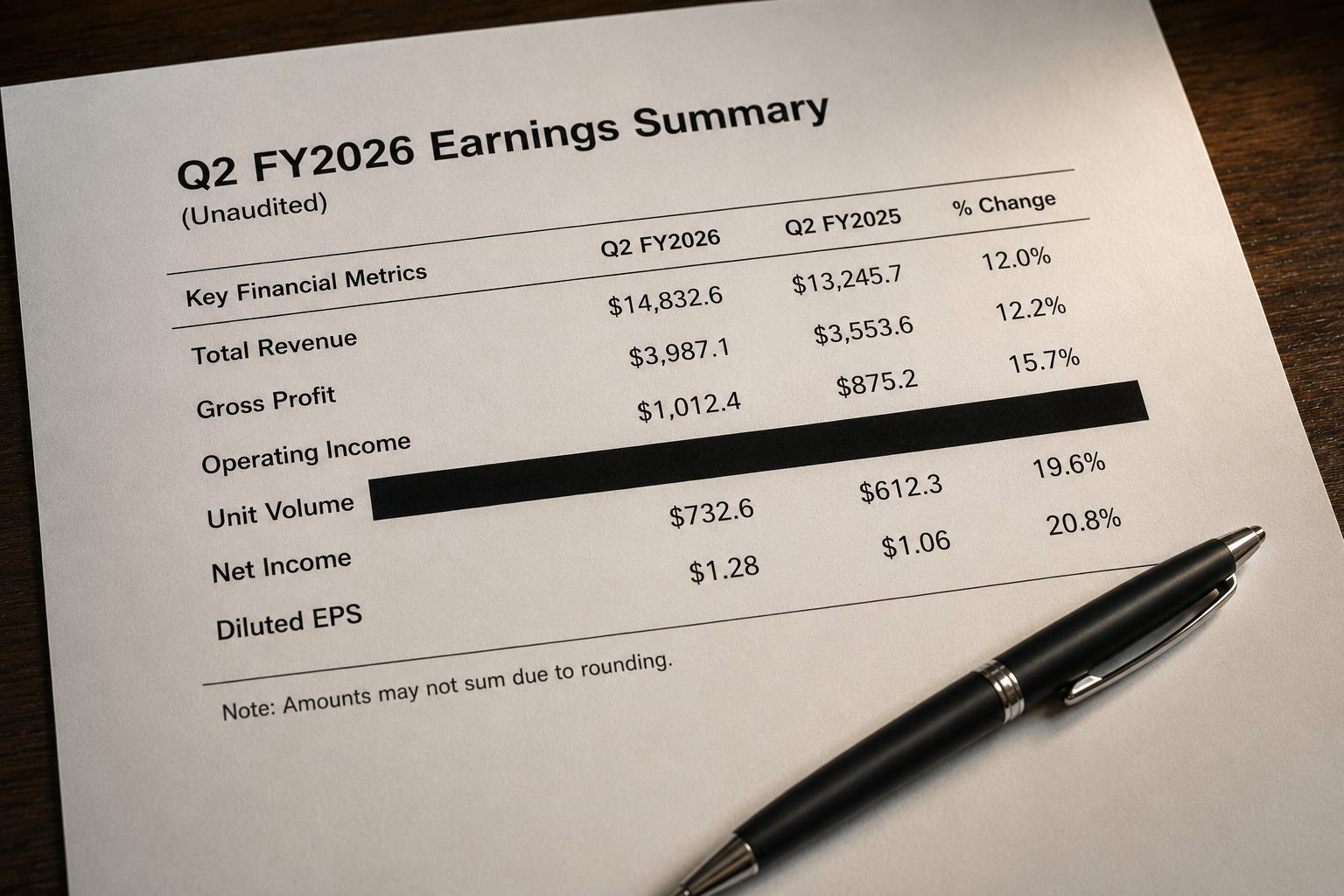
This is the first post in a 5-part series, The Unit Problem, on how grocers can reverse unit volume contraction.
TL;DR
Grocery unit volumes are down 1.8% year over year, and inflation can no longer hide it. Shoppers are buying less, trading down, and splitting trips across multiple retailers. The grocers that pull ahead will win on trip frequency and trust, not just price.
There is a metric that will never appear on a grocer’s financial report: unit sales. That absence is not an oversight.
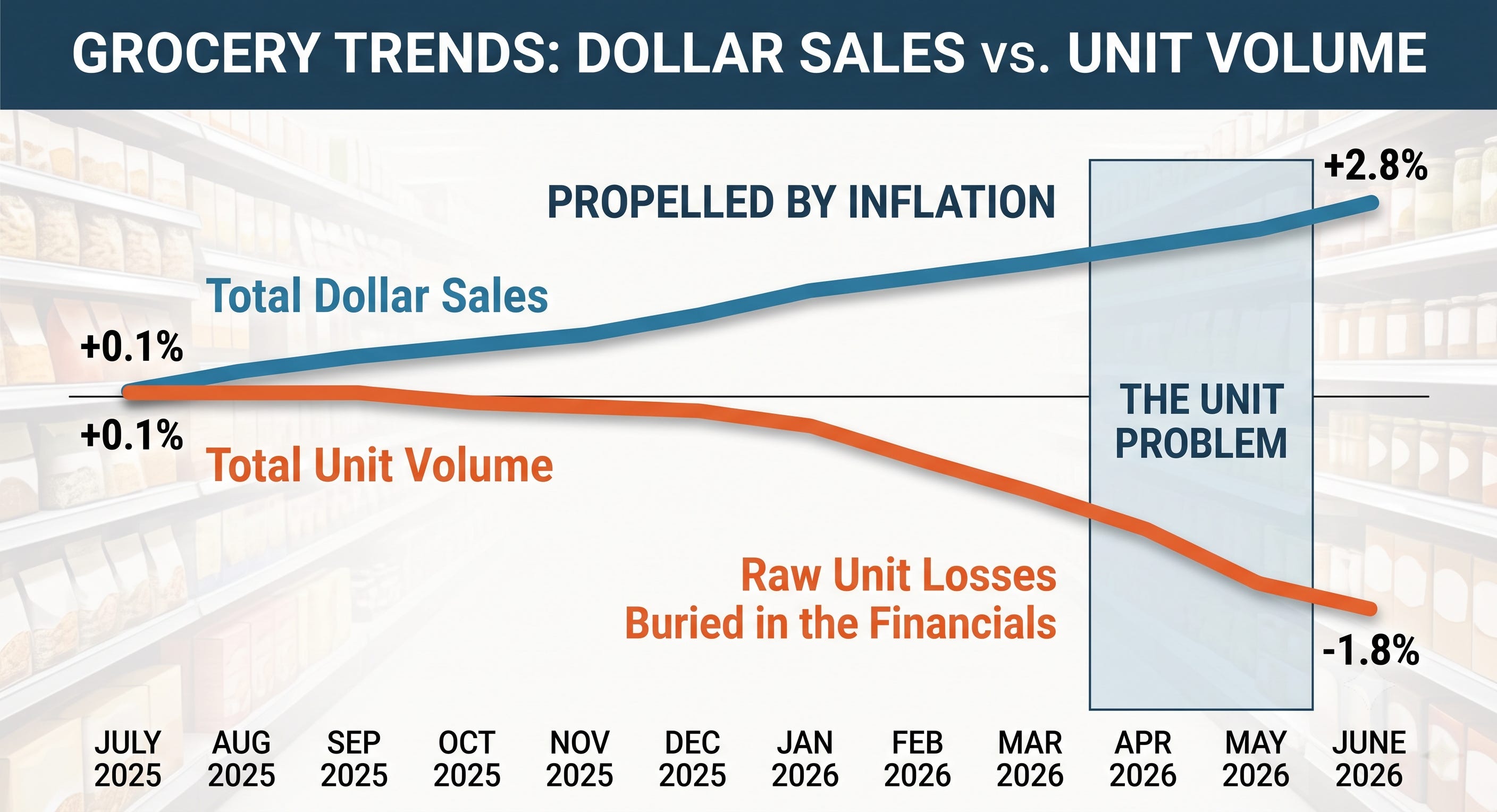
When unit volume contracts, grocers’ thin 1% to 3% profit margins get squeezed because fixed costs are spread across fewer items moving through checkout. So the reporting machinery moves to protect the narrative. Identical sales growth, propped up by inflation, leads the earnings call. Basket depth gets bundled into "average ticket size." Raw unit losses get buried in qualitative management discussion. The financials look stable while the volume story quietly deteriorates.
The Numbers Grocers Aren't Showing
Bain & Company went looking for that volume story in their analysis of NielsenIQ’s data1. Unit growth went negative in mid-2025. Then in February 2026 it stepped down sharply enough to pull actual dollar sales lower across the US. By June 2026, units were down 1.8% year over year. Twelve months earlier, they were up 0.1%. That is a nearly two-point deterioration in a single year, and it happened while prices were still climbing 2% to 3%.
Inflation did not cause the unit decline. Inflation was supposed to mask it. It stopped working.
How Shoppers Are Responding
Bain’s analysis points to overlapping pressures rather than a single shock. SNAP benefits were scaled back in late 2025, tighter eligibility rules followed in early 2026, and gas prices climbed over 20% in March. Consumers were already absorbing a 33% cumulative rise in grocery prices since 2019.
Among those trimming their bills, 56% are trading down to lower-priced brands, 49% are buying fewer items, and 44% are leaning harder on coupons. NielsenIQ panel data shows 22% of shoppers are now actively cross-shopping multiple banners to chase the best price on whatever matters most this week.
Value players, from discounters to mass and club, are taking trips from traditional grocers. Gaining shoppers does not resolve the unit problem. People are still buying less overall. The consumer who walks into your store instead of a competitor’s store is still buying fewer items than she was a year ago.
This is a contraction. Gaining share during a contraction is still winning, but it requires a completely different set of moves than the ones that worked during inflation.
The Trip Has Changed
McKinsey’s State of Grocery North America 2026 report surfaces the structural shift underneath the numbers2. Growth is now being driven more by purchase frequency, which increased 5% year over year from August 2024 to August 2025, than by basket expansion. Shoppers are not planning one large weekly mission and executing it fully. They are splitting trips across value stock-ups, fresh and prepared food occasions, convenience-led delivery runs, and targeted coupon sweeps.
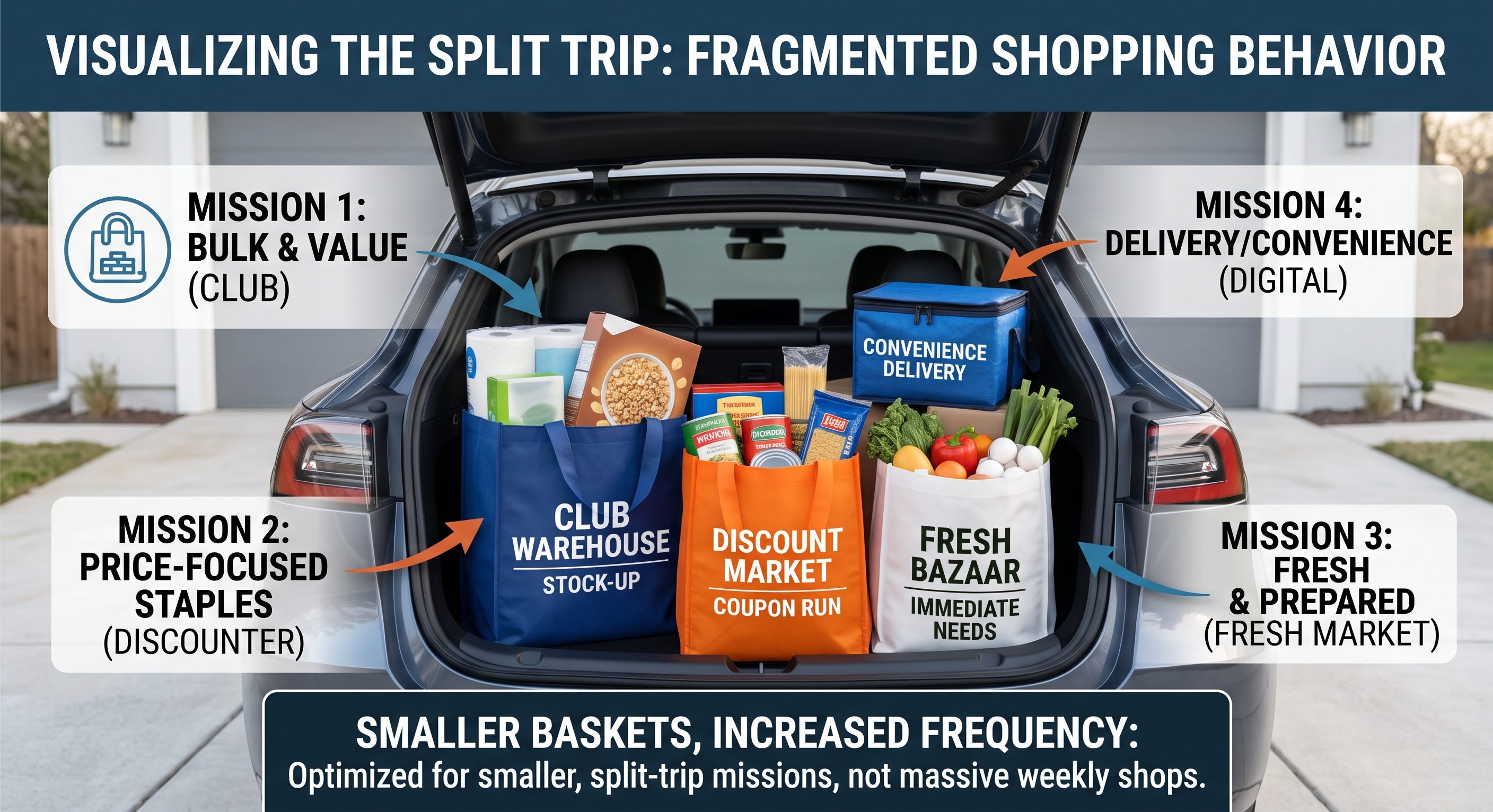
The traditional large-format grocer was built for the opposite behavior: big baskets, infrequent trips, and planned purchases. That model is under direct pressure from club stores on staple volume, c-stores and prepared food operators on immediate consumption, discount grocers on price perception, and delivery platforms on convenience.
What this means operationally is that grocers who are optimizing for basket size are optimizing for a shrinking shopping behavior. The grocer that learns to win on trip frequency, capturing smaller baskets more often across more missions, is playing the game consumers are actually playing right now.
What Comes Next
The edge goes to grocers who price sharply on the products shoppers notice, and use promotions, loyalty, and private brands with enough precision to build a value story shoppers can actually trust.
Trust is the operative word. The 33% cumulative price increase since 2019 did not just stretch budgets. It eroded the default assumption that a familiar banner is a safe choice.
Shoppers who used to drop $180 in a cart without much thought are running the numbers now. They know what eggs cost. They know what ground beef costs. They are watching those items as a proxy for whether the store is being straight with them.
That is the real problem underneath the unit problem. Consumers are not just buying less. The implicit contract between grocer and shopper has been tested, and a significant portion of the customer base found it wanting.
Rebuilding that contract is the work.
The Unit Problem is a five-part series on why US grocery unit volume is falling and what traditional grocers can actually do about it. Next, we’ll cover why digital channels became pruning tools, and what to build instead.
“The US Grocery Slowdown Is Real.” Bain & Company: https://www.bain.com/insights/the-us-grocery-slowdown-is-real-snap-chart
“The State of Grocery North America 2026.” McKinsey: https://www.mckinsey.com/industries/retail/our-insights/the-state-of-grocery-north-america