

You Fixed the Wrong Friction
The unit volume problem isn't at the register. It's in the three moments before shoppers ever gets there.

This is the fouth post in a 5-part series, The Unit Problem, on how grocers can reverse unit volume contraction. We began here.
TL;DR
Grocers spent billions fixing physical checkout. The shoppers they're losing never made it into their stores. List-building, substitution, and delivery/pickup windows are where unit volume actually disappears.
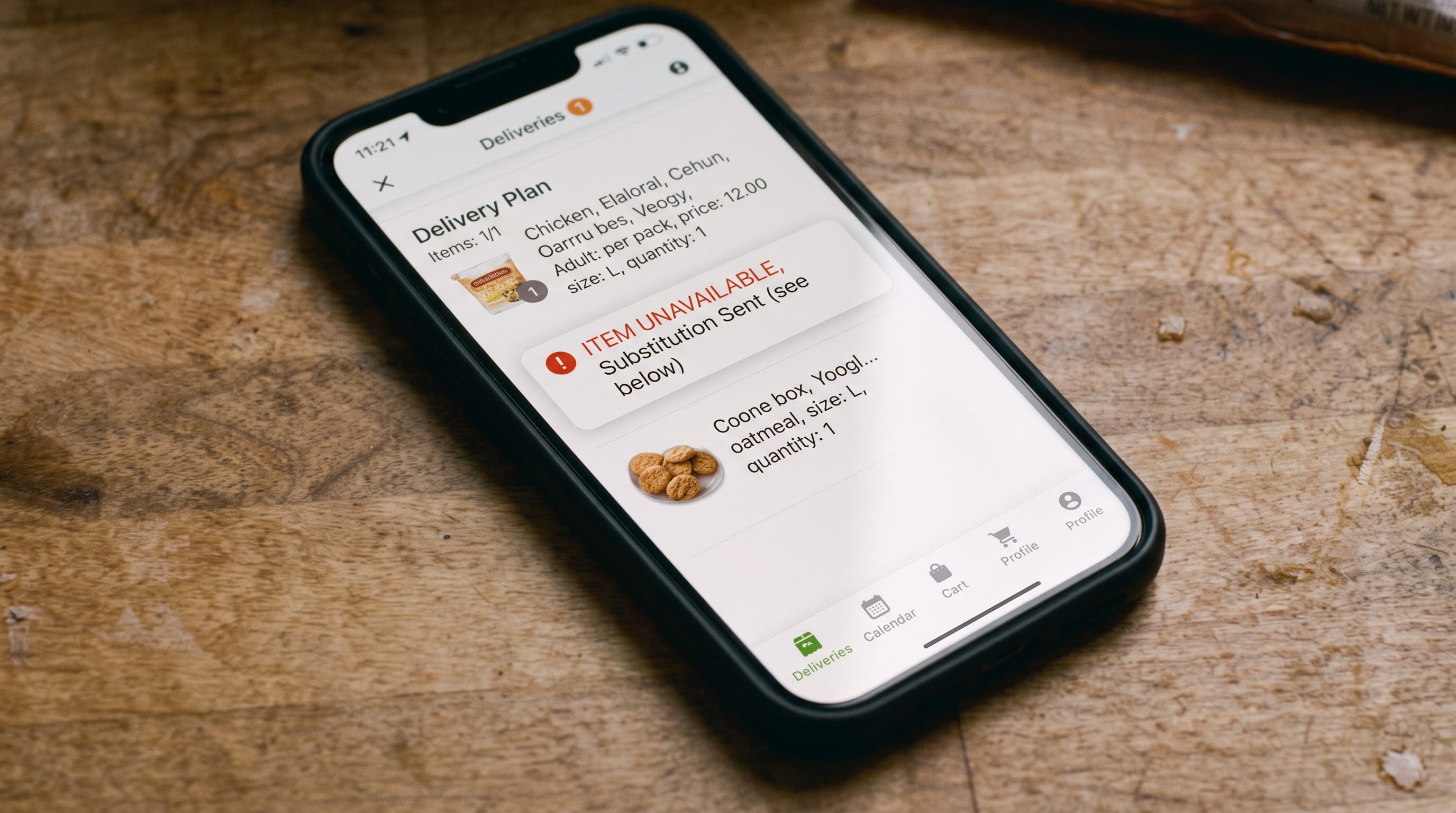
The grocery industry spent five years making the physical checkout faster. Amazon walked into grocery, scared everyone with what frictionless looked like, and the industry responded by throwing billions in capital at the last thirty feet of the shopping journey. With exceptions, most of it failed12.
The physical checkout is not where unit volume is leaking.
The Three Friction Points Nobody Fixed
The shoppers who abandon their carts at digital checkout are visible. The transaction fails, and the data captures it. The shoppers who get three substitutions they did not want on their pickup orders, accept them, and never place another order are harder to see. And the shoppers who built a mental list on Sunday night, opened the app Monday morning, could not find two items, and quietly decided Instacart was easier never show up in the data at all.
There were no failed transactions, no abandonment events tracked. The orders never happened, baskets never got built, and unit volume crashes.
Grocery has not solved that problem. It has been optimizing around it.
There are three points in the digital grocery journey where unit volume actually disappears. Checkout is not one of them.
The first is list-building. The shoppers who plan their trip in the app are the highest-value shoppers in the building. They arrive with intent, buy closer to their full list, and are far more likely to be loyalty members you can actually learn from.
Most grocery apps treat list-building as a notepad bolted onto a storefront. Search returns poor results for anything but an exact match, and there is almost no personalization pulling shoppers toward items they have bought before. They build half a list, get frustrated, and finish it in their heads on the drive over. Half those mental items never make it into the basket.
The second is substitution. Shoppers who place a pickup or delivery order and receive three substitutions they did not want do not complain to customer service. They place their next order somewhere else.
Substitution is where the grocer’s inventory problem becomes the shopper’s problem, handed off with a notification and a hope. The industry has put real money into substitution logic on the fulfillment side, better picker tooling, smarter item matching, and almost nothing on the shopper side.
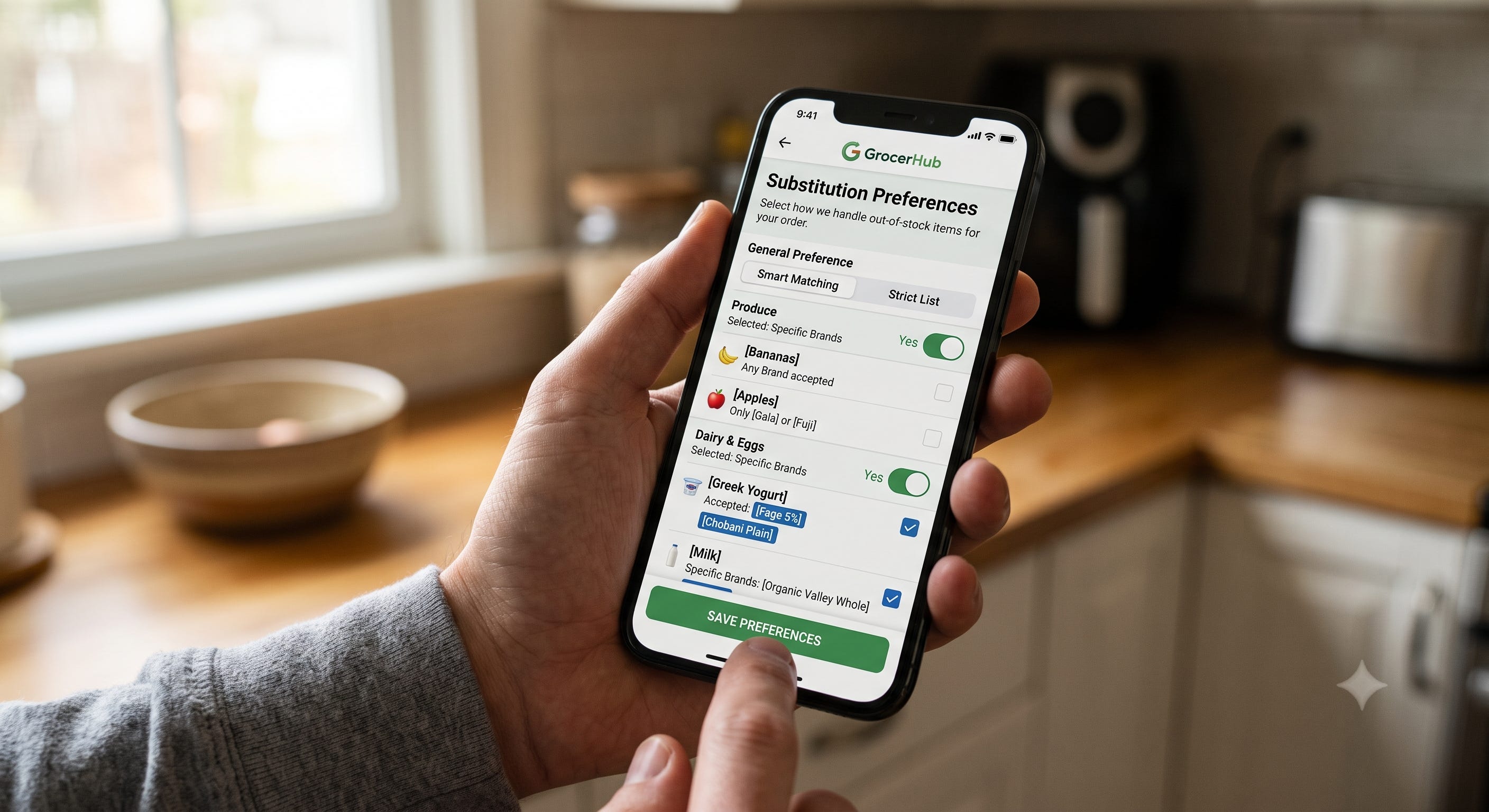
Shoppers should be able to pre-authorize preferences by category, rank what they will and will not accept, and trust that the system knows they will take Fage but not store brand on Greek yogurt. Most apps give them a binary: accept or reject after the fact. One of those outcomes is a satisfied customer. The other is a churned one.
Grocery has the lowest digital cart abandonment rate of any retail category, around 57%, a figure that has held across multiple industry analyses. Most grocers read that as a win. The likelier explanation is that volume loss is happening before the cart, in the list-building and discovery phase, where nothing gets tracked.
The third is pickup and delivery window selection. This one sounds operational, but it is a conversion problem. Shoppers who cannot find a window within two hours of when they need it either abandon the order or move to a competitor with more availability.
Kroger, Walmart, and Instacart have all invested in dynamic slot management. Most other grocers are still running static windows on a 24-hour refresh cycle. The shopper who wants a 5-6 PM delivery on Thursday and sees nothing until Saturday morning is a shopper Instacart just acquired.
What Checkout Optimization Actually Solved
Digital penetration varies widely by banner and market, but the direction of travel is the same everywhere: the share of orders touching a digital surface before checkout is growing, and the friction points upstream are growing with it.
Faster checkout reduced one real cost: associate labor at the front end. On margins that leave almost no room for error, that matters, and nobody should pretend otherwise. Scan-and-go also improved the experience for a specific type of shopper, the one buying eight items who does not want to stand in any line at all.
Those shoppers were already loyal. They knew what they wanted. They were not the conversion problem.
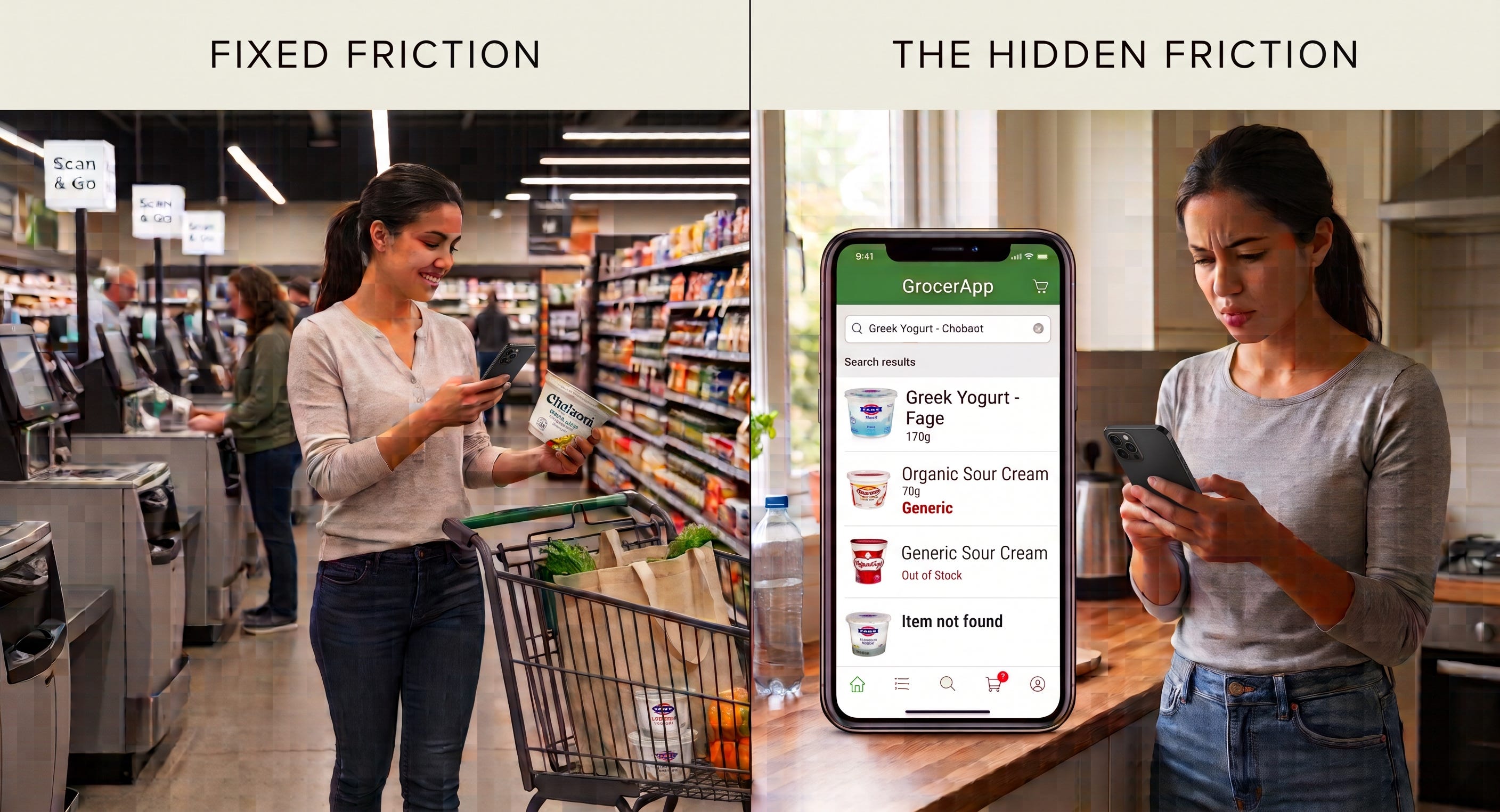
The conversion problem is the shopper still deciding whether any of this is worth the effort. They tried delivery twice and got bad substitutions. Their app keeps surfacing items that are out of stock. They cannot find a window that fits. They are one friction event away from deciding Instacart is just easier, margin be damned.
No amount of physical checkout optimization reaches that shopper.
Where the Next Infrastructure Dollar Goes
List-building, substitution preference, and slot availability are not glamorous investments. They do not photograph well in a press release. Nobody is cutting a ribbon on a new substitution preference UI.
But these are the three places where the digital grocery shopper decides whether to stay or go. Get list-building right, and unit volume grows among the shoppers worth keeping. Get substitution right, and you stop losing pickup and delivery customers after their second bad experience. Get slot availability right, and you stop sending Instacart new users every time your Thursday evening windows fill by noon.
The physical checkout investments made the stores faster for shoppers who were already there.
Grocers that do not fix these three things are not losing a price war. They are losing to a slow app, a bad substitution, and a full pickup window. That never shows up in the quarterly ops review. It shows up six months later, in a cohort chart nobody wanted to explain.
The Unit Problem is a five-part series on why US grocery unit volume is falling and what traditional grocers can actually do about it. Next, we'll explore the promotional engines and close with planning for the next 18 months.
“Is Self-Checkout a Failed Experiment?” Knowledge at Wharton: https://knowledge.wharton.upenn.edu/article/is-self-checkout-a-failed-experiment
“Amazon to Drop ‘Just Walk Out’ at Grocery Stores.” Payments Dive: https://www.paymentsdive.com/news/amazon-just-walk-out-checkout-payment-smart-cart-grocery/711999